Understanding these inner voices can quietly transform how you communicate, lead and connect.
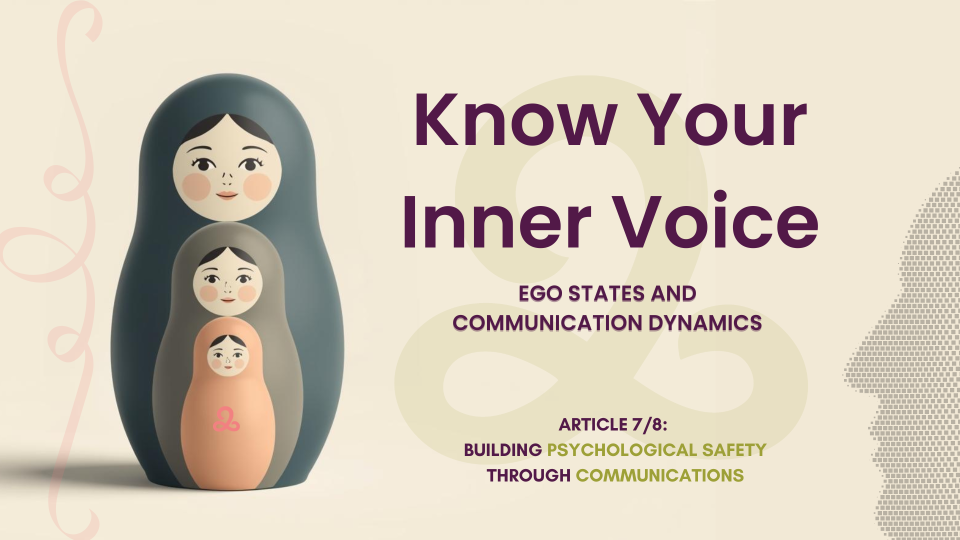
We each carry three of them within us: the Parent, the Adult, and the Child. Psychologist Eric Berne’s Parent–Adult–Child (PAC) model explains that we move between these ego states constantly sometimes in a single five-minute exchange.The Parent: The Voice of “Should”
The Parent is that inner voice that judges, corrects or protects. It’s formed from years of hearing authority figures like parents, teachers, bosses who often tell us what’s right or wrong. You might have heard these at your work too! Statements like:
- This needs to be done properly.” (Controlling Parent)
- “Don’t worry, I’ll handle it for you.” (Nurturing Parent)
When balanced, the Parent brings structure, care and high standards. But when it overreaches, it can make you feel smaller or incapable.
Here’s how:
Or:
A well-meaning mentor constantly “rescues” their team and help them by editing every document, stepping in on every client call. It feels supportive but over time it signals, “I don’t trust you to get it right.”
The Parent voice isn’t bad, it just needs some more awareness. Too much of it and we may silence others!
The Child is where our spontaneity, creativity and vulnerability live. It’s the part of us that feels deeply, plays freely and sometimes reacts impulsively.
At its best, it brings energy, ideas, and authenticity. At its worst, it can show up as defensiveness, avoidance or rebellion. Here are some examples to relate it better:
- You receive feedback and reply, “You always find faults with my work.” That’s the Adapted Child, reacting from old wounds.
- You stay silent even when you disagree because you don’t want to “cause trouble.” That’s the Compliant Child trying to keep the peace.
- You roll your eyes during a long meeting or mutter under your breath. That’s the Rebellious Child, trying to opt out but cannot!
- You pitch a bold idea with enthusiasm but without data or plan, that’s the Free Child with a heightened creativity which is unfiltered.
Every version of the Child carries history. Don’t mistake it with immaturity, it’s the emotional memory showing up in adult situations.
Then there’s the Adult, the part rooted in the here and now. It listens, observes and responds instead of reacting. The Adult doesn’t blame or defend; it seeks clarity. It’s the calm, emotionally intelligent voice that says:
- “I see your point; here’s what I was thinking.”
- “Help me understand what led you to that conclusion.”
- “I felt defensive earlier—can we revisit that conversation?”
Adult-to-Adult communication is the goal. It’s where psychological safety lives, where people feel not managed, micromanaged, or forgotten in the process. Try some of these to experience the Adult with a voice of balance:
- A team member misses a deadline. Instead of, "You're always late" (Parent) or “I’m sorry, I’m useless” (Child), the Adult says, “Let’s look at what caused the delay and how we can prevent it next time.”
- During conflict, instead of saying, “You never listen to me” (Child), you say, “I don’t feel heard right now; can we pause and try again?” That’s the Adult at talking.
Let's test this out now!
Picture this: your manager shares a plan you believe won’t work. Your Child wants to roll its eyes; your Parent wants to prove them wrong. The Adult takes a breath and says: “We both want this project to succeed. Can we explore another approach?”
You pause before reacting. You focus on shared goals. You use neutral language:
Instead of “You’re wrong,” try “Can we revisit this part?” Instead of “That won’t work,” try “Here’s what I’m concerned about.”
Each small shift keeps you grounded in the Adult state. .
Did you write your answers? Does it look something like this. The Parent voice might say, “They don’t know what they’re talking about,” or your Child voice may sound like, “They don’t respect me.”
So, what do you do? The moment you feel that pull, stay in your Adult and invite theirs out.
Let’s practice these instead:
- “That’s an interesting point. Tell me more about what makes you think that.”
- “I hadn’t considered it that way. What could happen if we tried your approach?”
- “Let’s figure out what both of us might be missing.”
Wow! Was it that simple? Is my parent and child voice actually under the control of the adult voice? Aha...that’s a good question and the answer to this is NO!
Here are some everyday traps that re-invite your parent and child voice again. You see these patterns all around:
- A “firm” email that sounds colder than intended! Parent mode on!
- A teammate who overexplains or apologizes too much. They are heavy on Child mode.
- A colleague who asks, “What does the data show us?” Tell me in the comments what do you think.
- A leader who says, “I hear your concern; let’s test both ideas” It’s the Adult inviting a dialogue.
All right! You are all set now with your adult voice ready to shine. But I also want you to know that the problem isn’t slipping into Parent or Child. It’s doing it unconsciously. So, awareness lets you course-correct before emotion hijacks the room.
Let me share some tips on how to build that awareness.- Catch your trigger: Think about your last tough conversation. What did you feel in your body? Whose voice took over? Was that a Parent, Adult or Child?
- Name it: When your parent or child tries to overpower, name it. “My critical Parent is speaking,” or “My defensive Child just showed up.” Naming creates distance more magically than you realize.
- Ask an Adult question: When tension rises, pause and ask, “What would be most helpful right now?” That question instantly brings you back to balance.
- Coach your Parent: When judgment creeps in, reframe it. From “They should know better” to “What might they be struggling with?” The same situation, but a completely different impact.
If you are a leader or one in leadership roles, practicing this alone can only take you halfway through. For a psychological safe workplace, it is extremely important to build an Adult-to-Adult culture. Teams that operate mostly in the Adult state share a few visible traits:
- Honest curiosity instead of defensiveness
- Accountability instead of blame
- The ability to disagree and recover quickly
And at the heart of it all, you can nurture that by modelling calm responses, naming unhelpful patterns gently or even saying, “Let’s reset this conversation at the Adult level.” It lightens tension and reminds everyone that maturity is more about awareness than age.
Now something from me to you!
The Parent in you offers wisdom. The Child in you brings heart and imagination. The Adult in you integrates both balancing the care with clarity, emotion with reason.
So next time you feel that familiar rise of defensiveness, pause. Ask, “Which part of me is speaking right now?” Real communication mastery actually is less about perfect phrasing and more about speaking from the right place.
And remember, psychological safety doesn’t begin in others. It begins in you when your Adult voice shows up first.


 Launch your Graphy