
There are no items in your cart
Add More
Add More
| Item Details | Price | ||
|---|---|---|---|
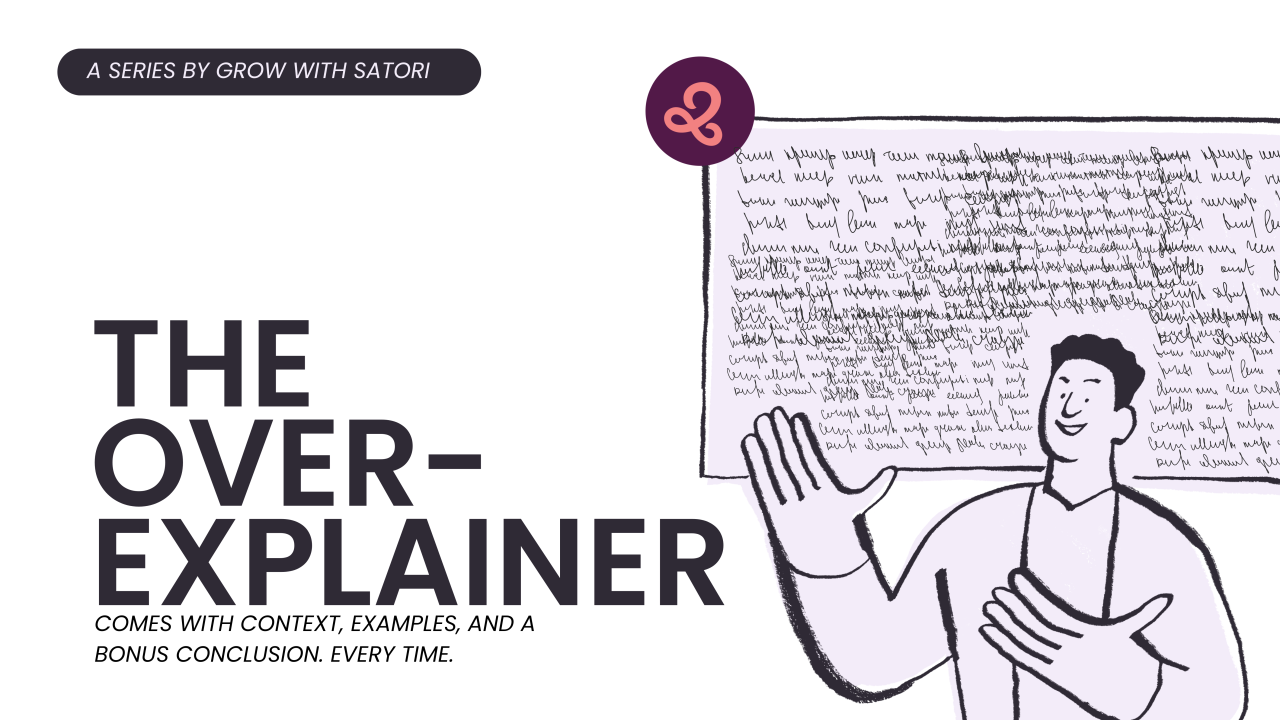 The Over-Explainer (Article 1 of 8) - Why some people can't just say it and what to do about it
It's a Monday morning standup. Someone asks Narad a simple question: "Did you send that report to the client?" And Narad proceeds to explain with full context that he had to first wait for the finance team's numbers, which came late because Vikram was travelling and then he had to cross-check with the previous quarter's data and also he wasn't sure if the format was right, so he re-read the email chain from three weeks ago, and yes, ultimately, he did send it but only after verifying with two colleagues. The report was sent. On time.
No one needed the backstory. But Narad couldn't help himself. Sound familiar? Welcome to the world of The Over-Explainer.
The Over-Explainer is so easy to spot. In fact, you have probably sat next to one in a meeting. Or seen one in your mirror.
Did you notice the common pattern here? The explanation outweighs the information and people are lost in the context to even try to look for a conclusion. But why does that happen? Because nobody wakes up in the morning and says, 'Today, I will explain myself into oblivion.'
So Why Do People Over-Explain?
Low Psychological Safety
People over-explain as a defence mechanism and when you look closely, it's always a signal that they don't feel psychologically safe. When the fear of being judged, dismissed or blamed is high enough, justifying every detail feels like the only way to stay protected. Give enough context and no one can pin the blame on you. They would pre-empt every objection so that no one can catch them off guard.
Think about Arjun, a new team lead who grew up in a workplace where every mistake was interrogated in front of the whole team. His manager's modus operandi was: 'Walk me through exactly how this happened.' Naturally, Arjun learnt to always walk people through exactly how everything happened, whether they asked or not. For Arjun, it was an armour, though this armour is capable of exhausting Arjun and everyone around him.
Perfectionism and the Fear of Being Misunderstood
Over-explainers often have a high bar for being understood correctly. They have had their share of experiences where they were misquoted, taken out of context or had their words used against them. So, in protection, they add layers with more detail, more qualifiers, and more 'what I actually meant was', hoping to seal every possible gap in interpretation.
Cultural and Structural Conditioning
In many workplaces across global corporate cultures, there's an unspoken rule: demonstrate effort more than the outcome. The more visible your process, the more credible you appear. Over time, people learn to explain with thoroughness, even when no one asked for it.
New managers are especially vulnerable here. When you are newly in charge, every decision feels like a trial and justifying everything feels responsible. In reality, it's not... but it feels that way.
Imposter Syndrome Peeping In
Over-explaining is sometimes a disguised imposter syndrome, like, 'If I don't explain why I made this call, they will think I don't know what I am doing.' Prima facie, it may look like diligence. But underneath, it could the fear of 'What if they find out I'm not as competent as they think?'
A note for managers: If someone on your team over-explains frequently, resist the urge to roll your eyes. Instead, ask yourself, what message have they received about what happens when they get something wrong? The over-explaining is pointing towards a signal, don’t look at it like a flaw.
We all know that over-explaining is one of those behaviours that seems harmless, even considerate at first. In practice, it has its own costs.
The Cost: How Over-Explaining Drains Teams
Derailed Meetings and Exhaustion
Every minute spent on context that wasn't asked for is a minute stolen from the actual agenda. A 60-minute meeting with two or three Over-Explainers can easily accomplish what should take 20 minutes. By the end of the meeting, everyone's behind and nobody quite knows what was decided. Moreover, processing unnecessary information is cognitive work. Your team is already managing tasks, priorities and their own stress. Receiving a three-paragraph message when a one-liner would do; adds to their load. Over time, people start tuning out, which is the exact opposite of what the Over-Explainer wants.
It Erodes Confidence — Theirs’ and Others'
When someone over-explains every decision to their team, it signals: 'I am not sure you will trust me unless I prove myself.' Teams pick up on this. Ironically, the more you over-explain, the less confident you appear, even if your work is excellent.
It Buries the Point
Important information gets lost in the story and context. If everything is explained equally, nothing stands out. Your actual recommendation, the key risk, the decision that needs to be made. All of it competes with a sea of background detail.
The irony: Over-explainers are often trying to build trust through detail. But the detail itself erodes trust in their ability to communicate clearly. Less, said well, does more.
Building a 'Say Less, Say Clearly' Culture
Whether you manage an Over-Explainer, are one yourself, or work in a team where this pattern has become the norm, let us share few tips for you to deal with this.
For Leaders and Managers: Create an environment where people don't feel they need an armour. This means:
For the Over-Explainer Themselves:
The first step is awareness. Start asking yourself: 'Was all of that necessary? Or did I just explain the explanation?'
Try the BLUF method (Bottom Line Up Front). State your conclusion or request first. Then, only if needed, add the context.
For example, instead of "So I was going through the data and I noticed something, and I wanted to check with Priya first before mentioning it, and I know we're all busy, but I thought it might be relevant... the numbers are off by 12%."
Try: "The numbers are off by 12%. Here's what I think is causing it and what I recommend we do."
The second version takes 5 seconds. The first takes 40 and makes the listener anxious for the first 35 of them.
For the Team:
Norms are set collectively. A few small agreements have the ability to change a team's communication culture:
The Checklist
Let’s put all this together and create a checklist for you to keep handy all the time. Before sending that message or raising your hand in a meeting, pause and ask yourself three questions:
Now remove anything that answers your third question. What’s left is your actual communication.
If you manage a team or are stepping into a higher role, consider introducing what some teams call an informal 'Communication SLA', a shared agreement on how information is shared.
These norms, when made explicit, give Over-Explainers permission to do the thing they actually want to do - be clear, be trusted and be done with sooner.
And now, here’s a question for you to reflect on… Think of a recent moment where you explained more than was needed. What were you afraid would happen if you hadn't?
The goal isn't to become someone who says nothing. It's to become someone who says what matters with enough confidence that the context speaks for itself.
You don't need to justify your worth with every message. You have already earned your seat. Now just say the thing.

Ishita Mukherjee
 Launch your Graphy