
There are no items in your cart
Add More
Add More
| Item Details | Price | ||
|---|---|---|---|
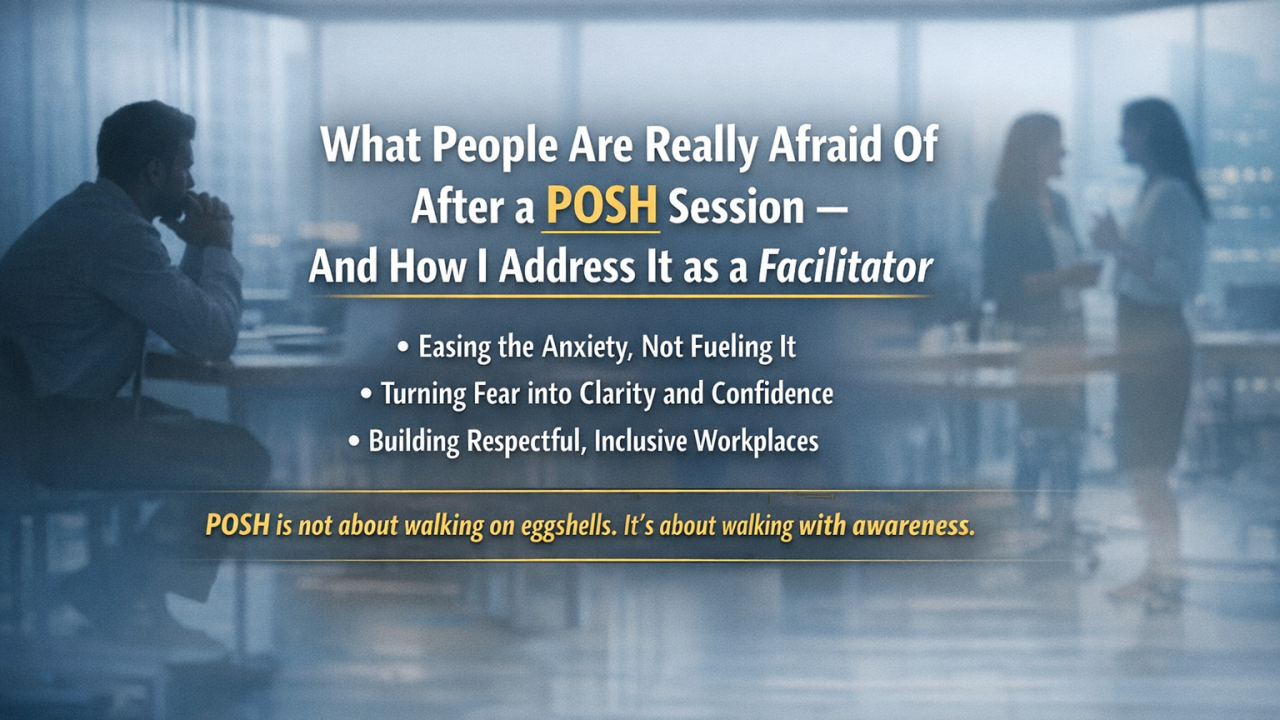
Recently, I delivered a POSH sensitization session for a large metals powerhouse in Bangalore.
Every time I run these sessions, my intent is very clear: POSH should feel like an enabler of safe, respectful workplaces and not a rulebook people walk away afraid of.
Especially today, when most organisations have gender‑neutral POSH policies, I don’t want participants second‑guessing every conversation, message, or handshake. I want them leaving with clarity, confidence, and practical guidance.
Yet, one pattern continues to show up. A common post‑session reality
After many POSH sessions, I notice this quietly but consistently:
Why does this fear show up more strongly for men?
Here’s what I’ve observed over multiple sessions and industries:
1. POSH often lands as “risk awareness,” not “behavioural clarity” - Many men hear POSH through the lens of “What could go wrong?” rather than “What does respectful, professional interaction actually look like?” When clarity is missing, the safest option feels like withdrawal.
2. Fear of misinterpretation - Without enough discussion on context, consent, and course‑correction, even neutral actions such as messages, humour, or handshakes, start feeling risky.
3. Silent emotional processing - Men often process discomfort quietly by changing behaviour or pulling back. Women are more likely to verbalise discomfort. Different responses, same underlying uncertainty.
4. Power dynamics hit differently - For many leaders, POSH introduces a new and uncomfortable truth: Intent may not matter but impact does.
That shift can feel destabilising if not explained properly.
Why women may not express fear as openly
This doesn’t mean women feel none.
One reframe I always emphasise in my sessions is this:
“POSH isn’t asking you to stop connecting. It’s asking you to connect with clarity, consent, and professionalism.”
How I design POSH sessions to reduce fear after the training
Before the session: Set the frame
During the session: Build confidence, not avoidance
I intentionally use phrases like:
“POSH is not about walking on eggshells. It’s about walking with awareness.”
If your POSH sessions currently leave people quiet, cautious, or withdrawn, the content may be compliant ... but the experience isn’t complete.
If you’re looking for POSH sensitisation that builds confidence, clarity, and respectful connection, I’d be happy to help.
Reach out to me for customised POSH sessions that people don’t fear and actually remember.
 Launch your Graphy