
There are no items in your cart
Add More
Add More
| Item Details | Price | ||
|---|---|---|---|
Let me start with something you will probably recognize. Remember the meeting where a conversation suddenly felt different? A colleague’s tone changed without a reason. Your idea got brushed aside a little too quickly. And that joke that did not land well with you. That moment lasted for three seconds, but it stayed with you for the next three hours, sometimes the whole day.
You were thinking about it while making your coffee. Though you told yourself that it wasn’t a big deal, you are also certain about the mental stress that it caused you, and you are unable to forget that sudden drop you felt in your stomach at that moment.
Well, these are the times when trust wobbles. You still trust that person, but you’ve built a guard around yourself, so you don’t have to face this again. And, weirdly enough, those wobbles say more about team culture than the organization’s big ‘values’ diagram ever will.
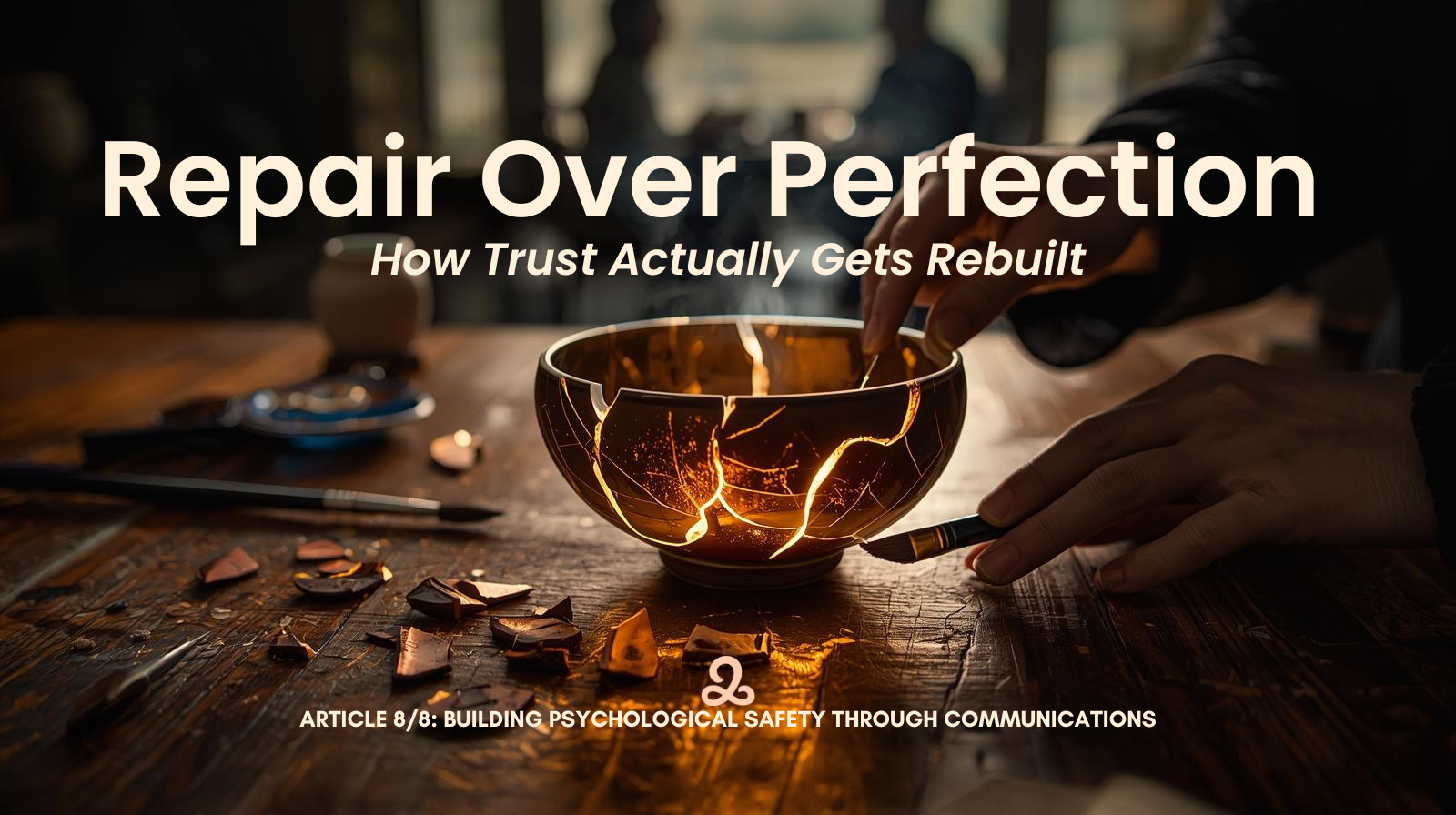
Since this is the last article in our eight-part series on Building Psychological Safety through Communication, it feels right to end where most real relationships actually grow. Surprisingly, relationships don’t get nurtured in perfect conversations, but in what we do after the imperfect ones.
Before we go further, here’s the quick path we have travelled together:
This is also called the rupture-and-repair cycle. The core takeaway of this cycle is that relationships don’t deepen when there is no tension. The depth is built by how people return after tension. Dr. Ed Tronick’s famous Still Face Experiment demonstrated decades ago that humans (including infants) regain trust when the other person re-engages after a moment of disconnect.
Even something simple like, “I think we both walked away with different interpretations during our brainstorming session. Would you like to meet and explore it more?” can dissolve the stress that’s been sitting between two people for days.
Ah! I hear what you’re saying: “That’s too much to do and it’s an inconvenience.” I guessed it. There are more people like my spouse, who will say anything to break the silence. After a disagreement a few years ago, when the conversation between us had reduced to only “yes” or “no,” for a whole day, he politely asked me, “Is your throat unwell? I noticed you’re responding in one word since morning.” Believe me when I say this, we both burst out laughing and actually forgot what really happened. I still remember the question but not the disagreement.
Ok, that was a home setup. Let me share how this version of repair would look like at the workplace. The colleague who cut short your response in the morning makes a conscious effort to communicate with more warmth that afternoon. The team member who sends a quick voice note saying, “I’ve been reflecting on our chat, and I think I understand what might not have landed well with you.” The leader who brings the group together after a tense discussion and says, “Let’s reset. We’re figuring this out together.” These moments may look small, but they signal care, and care almost always melts the invisible wall that messy conversations tend to create.
If we zoom out even further, repair is also about acknowledging that we interpret situations through our own histories. Words, tone, even pauses carry emotional weight differently for each of us. What felt like a passing comment to one person might feel like dismissal to another. This is why naming the moment matters. (If you’ve consistently read all the previous articles, I know you’d say, “Naming again!”) Hold on, let me clarify it. Without naming it, people start filling in the blanks with their own fears, assumptions and insecurities. This is the space that feeds to the ‘distance’ in relationships.
In teams, the practice of naming the messy conversation nudges members to initiate the repair regularly. People recover faster after disagreements. They call out misunderstandings before they turn into resentment. They apologise without shame or feeling of being judged because apologising isn’t seen as losing power anymore. And they trust that the relationship can handle an imperfect moment, which ironically makes communication smoother over time.
So if there’s one thing to take away from this entire series, it’s that psychological safety doesn’t come from flawless communication. It comes from the confidence that even when we misstep, we’ll find our way back to each other. The moment we choose repair, we choose the relationship and the people involved in it. And when enough people make that choice consistently, a team goes beyond being a high-performing team — it becomes a team made up of humans who deeply engage, deeply trust, and deeply repair.
Now I’m turning to you: what’s one repair you’ve been avoiding that might actually bring more ease into your day? Share it in the comments.

 Launch your Graphy